Understanding Types of Polishing Wheels and Compounds for Cutlery
A quick overview of the topics covered in this article.
In the production line of stainless steel cutlery, polishing is a key step that decides the final look and quality of the product. From a rough stamped spoon to a mirror-like pot, many polishing steps are needed. In this process, polishing wheels and polishing compounds work together like a perfect team. When they are matched correctly, you get high efficiency and high quality.
This article will introduce the common types of polishing wheels and the color code system of polishing compounds used in stainless steel cutlery polishing. It will also explain how to match them for different steps and materials. Whether you are a production manager, process engineer, or maintenance worker, this guide will help you improve your process, reduce cost, and increase product quality.
Part 1: Polishing Wheels – Types and Applications
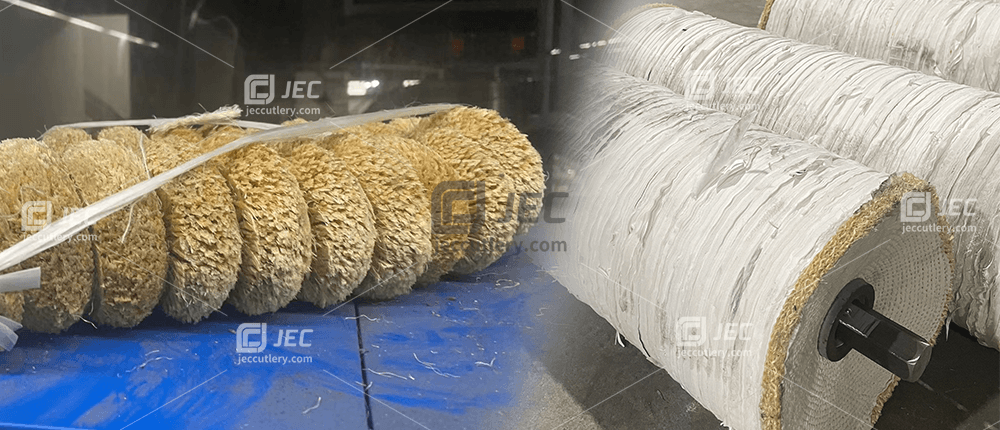
The polishing wheel is the consumable that touches the workpiece directly. Its material, hardness, and weave decide how much material it can remove and how fine the surface becomes. In stainless steel cutlery production, three types of polishing wheels are commonly used.
1. Sisal Wheel (For Rough Polishing)
- Material: Made from hard fibers such as sisal or manila hemp. Sometimes mixed with abrasive grains.
- Features: High hardness, strong cutting power, good heat dissipation. Leaves deeper marks.
- Step Used: Rough polishing. Used to remove burrs, weld spatter, deep scratches, and oxide scale.
- Example on Cutlery: Removing burrs after stamping; grinding weld lines on pots.
2. Cloth Wheel (For Medium and Fine Polishing)
- Material: Made from cotton, polyester, or blended fabric. Can be made with different hardness and stitching density.
- Hard cloth wheel (tightly stitched): Medium cutting power, used for medium polishing.
- Soft cloth wheel (loosely stitched or unstitched): Low cutting power, used for fine polishing.
- Features: Provides both cutting and gloss. This is the most widely used type in polishing.
- Step Used: Medium polishing (hard cloth wheel); fine polishing (soft cloth wheel).
- Example on Cutlery: Smoothing spoon surfaces and fork tines; removing marks from rough polishing.
3. Wool Wheel (For Mirror Polishing)
- Material: Natural wool or high-quality synthetic fiber.
- Features: Very soft, almost no cutting power. Creates very high gloss and mirror effect.
- Step Used: Final polishing (mirror finish).
- Example on Cutlery: Mirror finish on high-end knives, forks, and stainless steel pots.
| Wheel Type | Hardness | Cutting Power | Recommended Wax | Process Stage |
|---|---|---|---|---|
| Sisal Wheel | Very hard | Very strong | Yellow/Purple wax | Rough polishing |
| Hard Cloth Wheel | Hard to medium | Medium | Purple wax | Medium polishing |
| Soft Cloth Wheel | Soft | Weak | Green wax | Medium to fine polishing |
| Wool Wheel | Very soft | Almost none | White wax | Mirror finishing |
Part 2: Polishing Compounds – The Color Code System
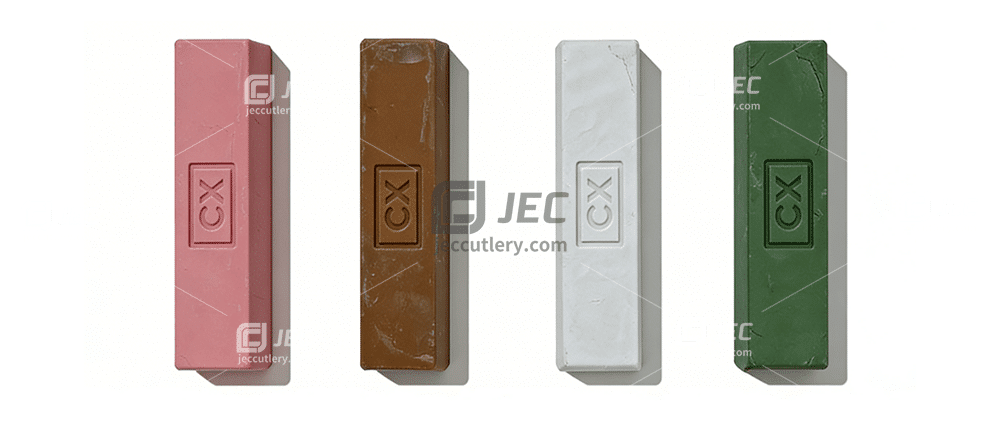
Polishing compounds are made of fine abrasive grains, a wax base (such as stearic acid and paraffin wax), and functional additives. Different colors mean different abrasive types, grain sizes, and cutting power. This forms an industry-wide color code system.
- Yellow wax: General-purpose, good oiliness. Used for removing burrs, deep scratches, and oxide layers from stainless steel cutlery.
- Purple wax: Strong cutting power with balanced gloss. Ideal for intermediate polishing of stainless steel pots and utensils.
- Green wax: Contains chromium oxide, mild cutting action, produces a bright satin to near-mirror finish. Suitable for precision parts.
- White wax: Ultra-fine abrasives (cerium oxide or silica). Provides true mirror finish for high-end cutlery.
| Color | Abrasive Grit | Cutting Power | Gloss Level | Main Process |
|---|---|---|---|---|
| Yellow | 180–400 mesh | Very strong | Fair | Rough polishing |
| Purple | 400–800 mesh | Medium | Good | Medium polishing |
| Green | 800+ mesh | Weak | Excellent | Fine polishing |
| White | Micron-level | Very weak | Outstanding | Mirror finishing |
Note: Different brands may have small differences. Always test a small batch before full production.
Part 3: Matching Wheels and Compounds for Each Polishing Step
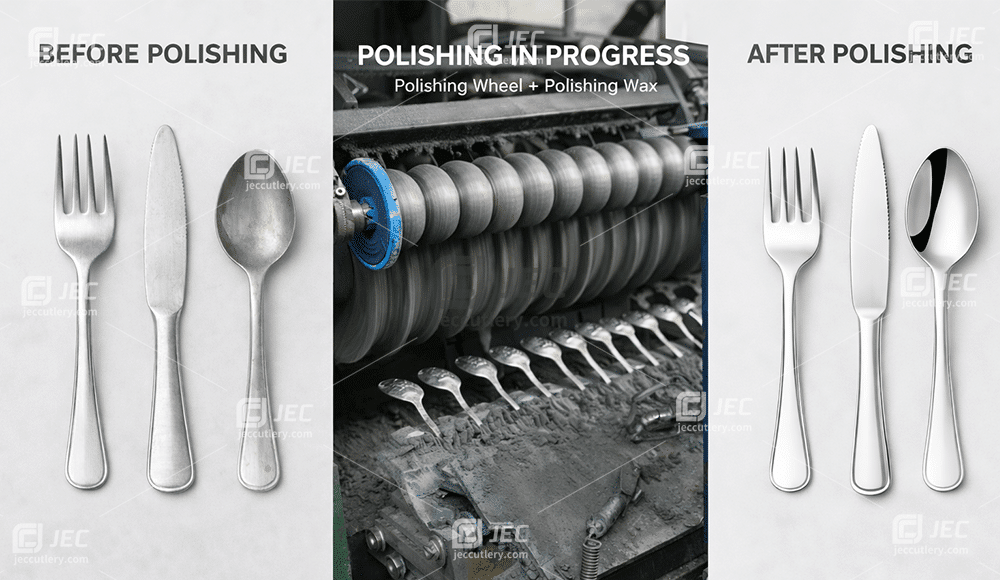
The typical polishing process for stainless steel cutlery has three steps: rough → medium → fine. Below is the recommended setup for each step.
Step 1: Rough Polishing – Remove Burrs and Defects
- Goal: Remove stamping burrs, weld spatter, deep scratches, and oxide scale.
- Recommended wheel: Sisal wheel (first choice) or very hard cloth wheel.
- Recommended compound: Yellow wax (stronger cutting).
- Process tips:
- Pressure: 0.15-0.25 MPa. Line speed: 20-28 m/s.
- Higher temperature (60-80°C) is allowed, but avoid overheating that changes the metal color.
- Example on cutlery: After stamping, a spoon blank has sharp burrs on the edge. Use a sisal wheel with yellow wax. Move evenly along the edge until all burrs are gone and the surface shows uniform rough marks.
Step 2: Medium Polishing – Smooth Surface and First Gloss
- Goal: Remove marks left by rough polishing. Make the surface smooth with a satin-like gloss.
- Recommended wheel: Hard cloth wheel (tightly stitched).
- Recommended compound: Purple compound (best balance).
- Process tips:
- Pressure: 0.1-0.15 MPa. Line speed: 25-30 m/s.
- Keep temperature at 40-60°C to avoid melting the wax base too fast.
- Example on cutlery: After rough polishing, the spoon surface still has directional marks. Change to a hard cloth wheel with purple wax. Cover the whole surface evenly. The marks become lighter and random. The surface feels smooth.
Step 3: Fine Polishing – Mirror Finish
- Goal: Achieve a mirror-like gloss. Surface roughness Ra ≤ 0.01 μm.
- Recommended wheel: Soft cloth wheel (for fine polishing) or wool wheel (for mirror finish).
- Recommended compound: Green compound (high gloss) or white compound (extreme mirror).
- Process tips:
- Pressure: 0.05-0.1 MPa. Line speed: 30-35 m/s.
- Strict temperature control (30-50°C). Use coolant if needed.
- Example on cutlery: After medium polishing, the spoon surface is smooth but not mirror-like. Change to a wool wheel with white wax. Use light pressure and fast movement. Finally, a clear mirror reflection appears.
Part 4: Differences for 304 and 316 Stainless Steel
304 and 316 are the two most commonly used materials for stainless steel tableware, but their different compositions determine the choice of polishing wax:
- 304 stainless steel (18% chromium + 8% nickel): Suitable for most tableware products. For polishing, it is recommended to use yellow or purple wax for rough polishing, white wax for medium polishing, and green wax for fine polishing. This combination provides a good balance between efficiency and cost.
- 316 stainless steel (with added molybdenum): It has higher hardness and stronger corrosion resistance, making it ideal for high-end tableware and medical-grade products. For polishing, it is recommended to use white wax No. 1 (90w1) for rough polishing, white wax No. 2 (90w2) for medium polishing, and a finer green wax for final polishing.
Part 5: Practical Polishing Tips and Common Problems
| Problem | Possible Cause | Solution |
|---|---|---|
| Deep, long scratches after rough polishing | Sisal wheel too hard or yellow compound too coarse | Use a slightly softer sisal wheel or reduce pressure |
| Rough marks still visible after medium polishing | Purple wax not cutting enough, or too short time | Apply more purple compound, increase medium polishing time |
| Insufficient gloss after fine polishing | Compound too coarse or rotation speed insufficient | Replace with white/green wax and increase the rotation speed |
| Uneven waxing on polishing wheel | Improper waxing technique or excessively hard wax block | Using a “small quantity, multiple times” approach, first use a tool to carve grooves on the wheel surface |
Conclusion
Understanding polishing wheels and polishing compounds is not just technical knowledge. It directly affects your factory’s consumable costs, product quality, and rework rate.
Choose the right polishing wheel types and waxes based on your stainless steel grade, desired surface finish, and part shape. This helps you achieve consistent, high-quality results. It also extends tool life and reduces waste.
A quick overview of the topics covered in this article.