How to Choose the Right Polishing Machine for Stainless Steel Cutlery
A quick overview of the topics covered in this article.
For manufacturers of stainless steel knives, forks, and spoons, the polishing stage is where functional items become quality products. A smoothly finished edge or a consistently reflective surface directly impacts a buyer’s perception of your brand. Choosing the correct polishing machinery is therefore a critical business decision that affects your product quality, production efficiency, and operational costs.
This guide will walk you through the essential factors to consider when building an effective polishing system for cutlery production.
What Is Cutlery Polishing?
Cutlery polishing is a finishing process used to remove surface imperfections, burrs, and tool marks from stainless steel items after they have been formed (e.g., by stamping or forging). The goal is to achieve a desired surface finish—whether a high-gloss mirror or a uniform satin sheen—while preparing the piece for final use or further treatment.
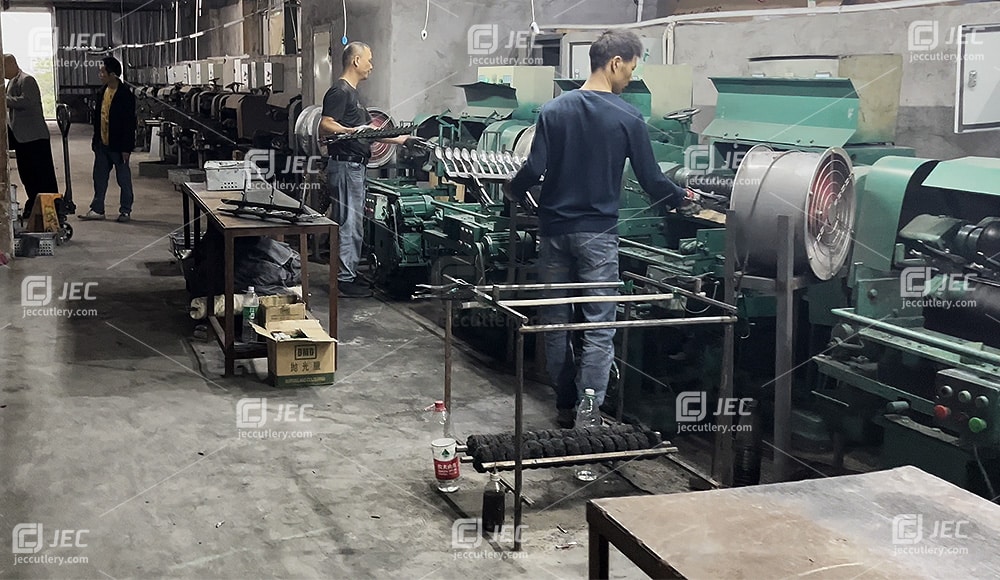
This process is typically mechanical, involving the use of rotating wheels or belts made from various materials (such as sisal, cloth, or non-woven abrasives) in conjunction with polishing compounds. Modern manufacturing moves this process from manual labor to specialized machinery to ensure consistency, speed, and quality across large production volumes.
Key Factors for Selecting a Cutlery Polishing Machine
Unlike general-purpose machine tools, cutlery polishing machines are often highly specialized. Your choice should be guided by three primary factors: your product mix, your target finish, and your production scale.
1. Product Mix: Matching Machine to Cutlery Type
The shape of your products is the first and most important filter. Different cutlery items present unique challenges.
- For Knives: The main areas to polish are the flat blade surface and, most critically, the edges and transitions—specifically the curved radius where the handle meets the blade. You need machines capable of handling long, straight sections as well as these complex curves.
- For Spoons: A spoon has two distinct sides. The inner bowl (concave surface) requires a machine that can fit snugly without applying any force that could cause deformation. The outer back (convex) needs uniform pressure for a consistent finish. These are often best handled by dedicated inner-arc and outer-arc polishing machines.
- For Forks: Forks are the most complex due to the gaps between the tines. The finish must be uniform on the tips, the outer edges, the handle, and the inner slots between the tines. This often requires a combination approach: using edge polishers and surface polishers to process the contours, and use specialized machines to process the fork seams.
Unlike general-purpose machine tools, cutlery polishing machines are often highly specialized. Your choice should be guided by three primary factors: your product mix, your target finish, and your production scale.
2. Desired Finish: Defining the Surface Quality
Your target surface quality determines the type of polishing media, the number of process stages, and the machine’s required capabilities.
- Mirror Finish (High-Gloss): This is a multi-stage process. It typically starts with an aggressive cutting stage using a wheel like sisal with a compound to remove deep scratches. This is followed by one or more coloring stages using softer wheels like cloth to refine the surface to a mirror shine. Machines that can accommodate multiple spindles or be integrated into a sequence are essential for efficient mirror finishing.
- Satin / Brushed Finish (Matt): This requires creating a uniform, linear grain pattern. Consistency of pressure and direction is key. Machines that use abrasive belts or non-woven wheels, and which can maintain a steady back-and-forth or linear motion, are best suited for this finish.
Unlike general-purpose machine tools, cutlery polishing machines are often highly specialized. Your choice should be guided by three primary factors: your product mix, your target finish, and your production scale.
3. Production Scale: From Manual Replacement to Automated Lines
The volume you produce will dictate the level of automation you need.
- Low to Medium Volume / High Mix: For factories producing a variety of items or smaller batches, semi-automatic, single-purpose machines are an excellent step up from manual polishing. They are typically easy to set up and operate, reducing reliance on highly skilled manual polishers while significantly improving consistency for specific tasks like edge grinding or bowl polishing.
- Satin / Brushed Finish (Matt): This requires creating a uniform, linear grain pattern. Consistency of pressure and direction is key. Machines that use abrasive belts or non-woven wheels, and which can maintain a steady back-and-forth or linear motion, are best suited for this finish.
Types of Cutlery Polishing Machines by Function
While CNC machine tools are often classified by axes, polishing machines for cutlery are best understood by their function. A complete system is built by combining these specialized types.
| Machine Type | Primary Function | Best Suited For |
|---|---|---|
| Edge Polisher | Polishing the outer profile, tips, and handle edges. | Knives, fork tines, spoon rims |
| Inner Bowl Polisher | Polishing the concave surface of spoons and forks. | Spoon bowls, the inner curve of fork tines |
| Outer Curve Polisher | Polishing the convex back of spoons and forks. Ensures uniform pressure across the curved surface. | Spoon backs, fork backs |
| Plane/Flat Polisher | Polishing large, flat surfaces. Often uses a wide wheel or belt. | Wide knife blades, spatulas, pan handles |
| Double-Sided Polisher | Polishing two sides of a part (e.g., inner and outer curve of a spoon) simultaneously. | High-volume production of spoons and forks |
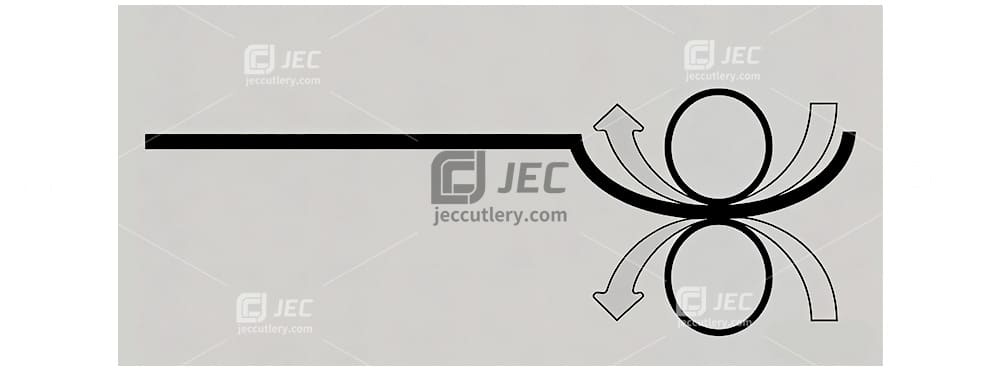
| Wheel Shaping Machine (Dresser) | Truing and flattening polishing wheels to prevent vibration and ensure consistent contact. | Maintenance and setup for all wheel-based polishers |
Step-by-Step Guide to Choosing Your Machine
Follow this process to make an informed decision:
- Step 1: Create a Product Matrix. List your top 3-8 products by volume. For each, note the material (e.g., 304, 420 etc. stainless steel), the critical areas to polish (edge, bowl, back, flat), and the target finish (mirror, satin).
- Step 2: Map Processes to Machines. Based on your matrix, identify which specialized machine types you need. For a standard spoon set, you might need an edge polisher, an inner bowl polisher, and an outer curve polisher.
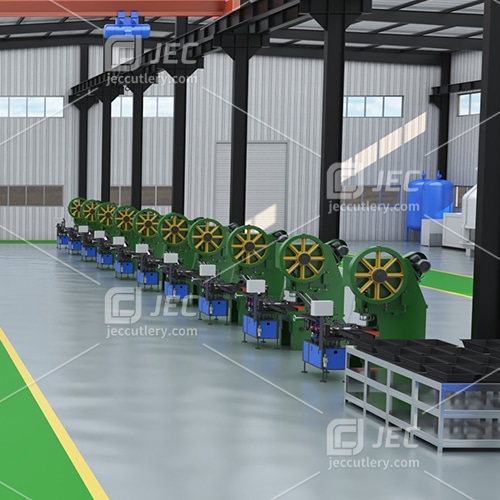
- Step 3: Plan for Integration. Think beyond single machines. Consider the floor layout and workflow. How will parts move from one machine to the next? Will you need operators for each station, or can they be linked with conveyors?
- Step 4: Consider Support Equipment. Don’t forget essentials like wheel shaping machines. Keeping your polishing wheels flat and true is vital for achieving consistent results and prolonging the life of your main equipment.
- Step 5: Match Motor Power to Material. Harder materials like 420 stainless steel require more powerful motors (e.g., 7.5kw or more) to maintain speed under load during the cutting stage.
Advantages and Considerations of Automated Cutlery Polishing
Investing in dedicated polishing machinery offers clear benefits, but it’s also important to understand the requirements.
Advantages
- Consistency & Quality: Automated processes eliminate human variation, ensuring every piece in a batch has the same high-quality finish.
- Increased Output: Machines operate at consistent speeds and can run for longer hours, dramatically increasing production capacity compared to manual polishing.
- Reduced Skilled Labor Dependency: It addresses the challenge of finding and retaining skilled hand polishers. Semi-automatic and automatic machines can be operated with less specialized training.
- Lower Long-Term Cost Per Piece: While the initial investment is significant, the speed, consistency, and reduction in rework lead to a lower cost per unit over time.
Key Considerations
- Initial Investment: The upfront cost of a series of specialized machines is substantial.
- Setup and Changeover Time: Switching a machine from polishing one part to another can require tooling changes and adjustments. This is a key factor for factories with a high product mix.
- Floor Space: An integrated polishing line requires considerable factory floor space.
- Maintenance: Like all automated equipment, polishing machines require regular maintenance to keep them running optimally and to prevent costly downtime.
How Much Does a Cutlery Polishing System Cost
There is no single answer, as the cost depends entirely on your specific needs.
- A single, semi-automatic edge polishing machine will have a relatively lower entry cost.
- A fully integrated line consisting of multiple specialized machines (edge, inner bowl, outer bowl, flat) will represent a significant capital investment.
The total cost is influenced by the number of machines, their complexity (e.g., number of axes, programmability), motor power, and the level of automation (e.g., manual loading vs. integrated conveyor). The best approach is to define your production requirements clearly and request a tailored quotation from a specialized machinery manufacturer.
Conclusion
Choosing the right polishing equipment is a strategic investment in your product’s quality and your factory’s efficiency. By carefully analyzing your specific cutlery types, desired finishes, and production volumes, you can move from a collection of manual tasks to a streamlined, automated polishing process that delivers consistent, high-quality results.
A quick overview of the topics covered in this article.